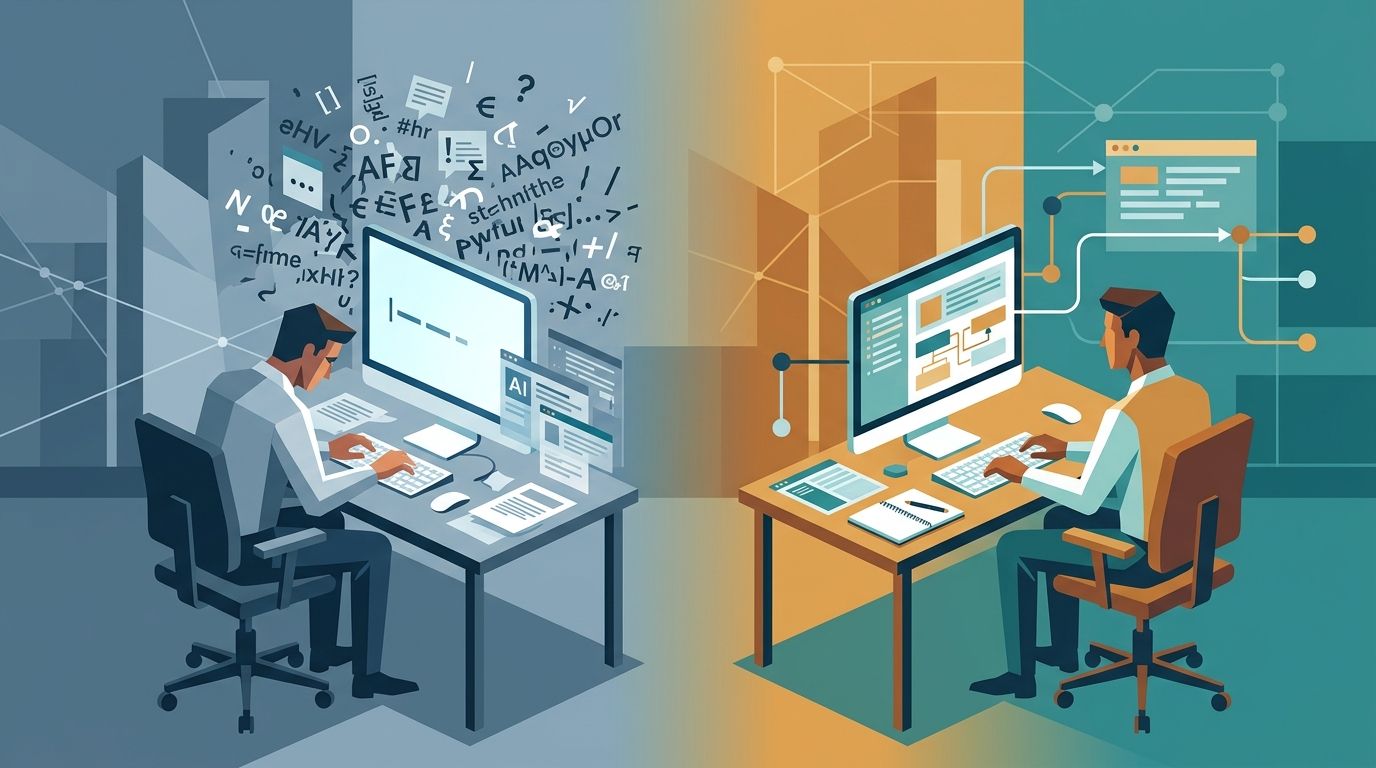
You've introduced AI into your work. Maybe you use ChatGPT for emails, Claude for documents, a specialized tool for meetings. Yet the persistent feeling, week after week, is that the tool isn't delivering what it promised.
You're not alone. 44% of professionals believe AI is causing more harm than good at their company. 25% say it hasn't saved them a single minute. These aren't people who haven't tried, they're people who tried, invested time, and saw no meaningful results.
The right question isn't "why doesn't AI work?" AI works. The question is: what's breaking down in the way it's being used?
In almost every case, it comes down to one of the four friction points below. Identifying which one applies to you is the first step toward fixing it.
Friction Point 1: You Added a Tool Without Redesigning the Workflow
This is the most subtle friction point and probably the most widespread.
Imagine buying a high-quality professional tool and inserting it into a process that was already inefficient. The tool does its part. The process stays broken. Result: more variables, not less complexity.
This is precisely what happens with AI. 47% of professionals report an increased workload after introducing AI tools into their workflow. 40% of the time theoretically saved by the tool gets consumed in reworking and correcting the output.
This isn't a paradox, it's the predictable consequence of layering a new tool onto an old process without redesigning the process itself. AI doesn't automatically fix a poorly structured workflow. In some cases, it amplifies the existing problems.
The signal to look for: do you often end up rewriting almost everything AI produced for you? Then the problem isn't the response, it's how you set up the task.
Friction Point 2: You're Asking Too Little and Complaining About the Answer
This friction point is more visible than the first, yet almost no one recognizes it in themselves.
30% of AI-generated content is irrelevant to the actual need. The technical reason is that AI has no access to the context you haven't provided. It doesn't know who you are, who you're writing for, what situation you're in, what format you need, what constraints you're working within.
When you write "give me a professional email for the client," you're asking for something that could mean a thousand different things. AI produces the statistical average of all those possibilities and the average is, by definition, generic.
Professionals who consistently get better results from AI don't use different tools. They use the same tools with structured input: the context of the situation, the role you want AI to play, the precise objective of the response, the expected format and length. This isn't magic, it's the same logic you'd use when briefing a skilled colleague instead of shouting a request across the office.
The signal to look for: are your prompts typically under two lines long? That's where the immediate improvement margin is.
Friction Point 3: You Don't Have a Method, You Have a Habit of Random Attempts
You use AI for whatever comes to mind in the moment. When you remember it exists, you use it. When you don't, you don't. Results range from excellent to disappointing, and you can't figure out why.
63% of workers have not received adequate AI training. This isn't just about not understanding how it works technically, it's about not having a system for knowing where to use it, when to use it, and which tasks are suited to the tool and which aren't.
The gap between professionals who get consistent results and those who get occasional results isn't talent. It's method. Ad hoc usage produces ad hoc results. Systematic usage - built around specific tasks, with standardized inputs and clear expectations - produces predictable and scalable results.
The signal to look for: can you describe in three precise sentences the use cases where you use AI every week? If the answer is no, you're improvising.
Friction Point 4: You're Delegating Tasks to AI That Require Verification
This is the most dangerous friction point, because its effects show up late.
83% of AI users have encountered at least one wrong answer delivered with the same confidence AI uses for everything else. This isn't a bug — it's a structural feature of how these systems work. AI doesn't retrieve verified facts: it generates statistically probable text. Plausible text and accurate text look very similar. Too similar, if you don't know what to look for.
More experienced users don't use AI less because of this — they use it differently. They treat it as an interlocutor capable of reasoning and structuring ideas, not as a source of facts. External verification, always, on critical data points. Trust the reasoning architecture; verify the specific information that feeds it.
The signal to look for: have you ever included in a document or presentation a piece of data that later turned out to be fabricated? If it's happened even once, you've already met this friction point.
These Friction Points Are Learnable
Here's the important thing: none of these four friction points are permanent. They're not limitations of the tool, and they're not limitations of yours. They're competencies that get built, like any other professional skill.
The 5% of professionals who consistently get better results from AI don't use different tools. They use the same tools with a different method. That difference is acquirable.
If you recognize yourself in one or more of these friction points, the From User to Orchestrator course is built precisely for this: not to explain what AI is, but to give you the method to use it in your daily work. From prompt structure to workflow design, from concrete use cases to agentic AI, 200 pages of practical content, in a format you open to the chapter you need today.