Nine hundred million people use ChatGPT every week. Two and a half billion prompts per day, according to numbers shared by Sam Altman in July 2025. If you counted every single request made to ChatGPT in 24 hours, you'd easily surpass the total Google searches conducted across entire countries in the same time window.
40% of those interactions are for writing text. 24% for practical guidance. 13.5% for seeking information. An unprecedented volume of usage, and yet the average quality of results remains surprisingly low. Not because the tool doesn't work. Because most people use it making the same five mistakes, session after session, without realizing it.
These are the five errors that anyone who works with AI professionally recognizes immediately, because they made every single one before learning to correct them. And the difference between those who correct them and those who keep repeating them isn't technical, isn't about the subscription tier, and isn't about intelligence. It's about awareness.
ChatGPT Is Not Google (but Almost Everyone Treats It That Way)
The first mistake is the most fundamental, and it has nothing to do with technique.
When someone opens ChatGPT for the first time, they treat it, almost inevitably, as a more sophisticated search engine. They type a question, wait for an answer, read it, move on to the next question. "What's the best project management software?" "How do I write a complaint letter?" "What are the digital marketing trends for 2026?" Perfectly legitimate questions. And ChatGPT handles them adequately. But that's not what it was built for, and using it this way means tapping into roughly 10% of its potential.
The distinction is simple: Google retrieves, ChatGPT generates. Google goes into a massive archive and fetches documents containing the words you typed. ChatGPT builds content based on the information you provide. When you ask it a blunt question with no context, you're forcing a content generator to do a search engine's job. The result is predictably mediocre.
The person who types "write an email to my client" is asking the machine to produce any email to any client for any reason in any tone. The AI doesn't have access to your inbox, doesn't know who your client is, doesn't know the context of your relationship, doesn't know whether the email is a response to a complaint, a sales pitch, or a crisis communication. It does what an employee would do if their manager said "write an email" without adding anything else: it produces something grammatically correct and completely useless.
The numbers confirm it. People who use structured methods report 37% higher satisfaction with outputs and develop effective prompts 65% faster. Research by METR on professionals working with AI documented that those with poor prompting habits take up to 19% longer to complete the same tasks compared to those who use the tool deliberately.
The cost of treating ChatGPT like Google isn't just a worse output. It's an hour a day spent fixing what the tool could have produced well on the first pass, if you'd given it the right context.
900 million weekly users. 2.5 billion prompts per day. Yet the majority of interactions produce results that need more revision than they should. The problem isn't the tool. It's how it's used.
"Write Something About X" Is Not an Instruction
The second mistake is the first one's sibling, but it shows up differently. Here, the user understands that ChatGPT generates content rather than searching for information. They know they need to ask it to produce something. But the request is so vague it's almost worthless.
"Write an article about digital marketing." "Prepare a presentation on our strategy." "Make me a plan for the next three months." These instructions sound reasonable but, in practice, force the AI to guess nearly everything: the audience, the context, the tone, the length, the level of detail, what to include and what to leave out. The result is generic text that requires as much rewriting as starting from scratch would have.
The fix isn't writing longer prompts. It's writing more specific ones. An analysis by TU Munich in 2025, covering over 2,000 prompt templates used in real business contexts, confirmed that the structure and order of components make a measurable difference. Four components: context, role, objective, format. Four questions to ask yourself before hitting enter, not a form to fill out.
Compare two versions of the same request and the gap becomes obvious.
Version A: "Write an email to my client."
Version B: "Write an email to my client Marco Bianchi, procurement director at a mid-size manufacturing company. We had a call last Friday where he raised concerns about delivery timelines. I want to apologize for the delay, briefly explain what happened, and propose a call this week to discuss solutions. Professional but warm tone, we've worked together for three years."
Version B isn't harder to write. It takes maybe thirty seconds more. But it radically changes the quality of what you get back. With Version A, you spend two minutes writing, ten minutes editing. With Version B, two minutes writing, two minutes editing. The real time savings always come from the more specific prompt.
People who work with structured prompts report quality improvements between 40% and 60%. This isn't opinion: it's the average result when users stop asking "write something about X" and start specifying for whom, in what context, and toward what goal.
The First Response Is Almost Never the Final One
This is the most subtle of the five mistakes, because it stems from an expectation that seems perfectly reasonable: I write the prompt, I get the result, done.
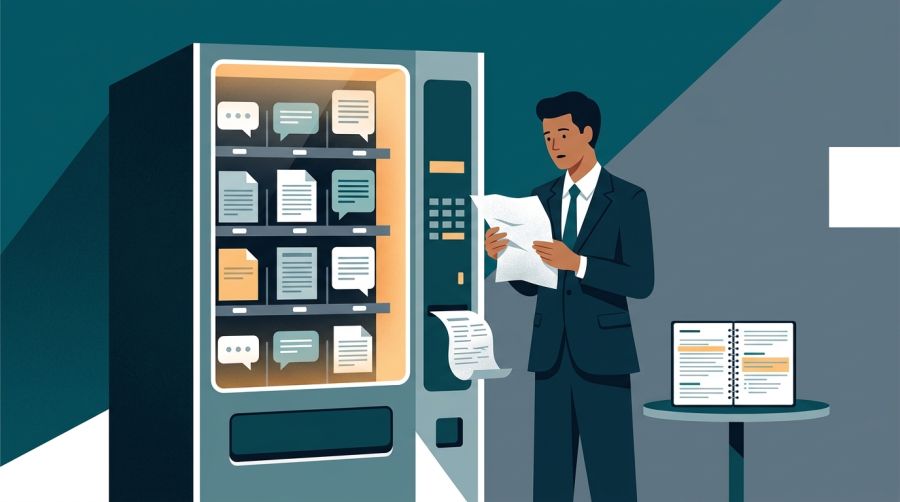
The problem is that ChatGPT isn't a vending machine. It's a conversation.
The vast majority of users write a request, read the output, feel somewhat dissatisfied, and then do one of the two worst possible things: close everything and start over, or accept a mediocre result because "at least I saved some time."
Professionals who use AI effectively do the opposite. They write the initial prompt, read the output, and then provide targeted feedback. Not "make it better," which tells the machine nothing. But "the tone is too formal for our audience, shorten the third paragraph, and add a specific reference to the launch price." Specific, direct, measurable.
The result after three or four exchanges is almost always superior to what any single prompt would have produced on the first try. And the total time is often less, because it's easier to describe what's missing in a text that already exists than to specify every detail of a text that doesn't exist yet.
There's another approach most users don't know about: asking the AI to write the prompt for you. It's called meta-prompting, a technique where you informally describe what you want and ask the machine to build the structured request on your behalf. Self-Refine research (2025) documented an average 20% quality improvement compared to unrefined starting prompts. In practice: if you don't know how to ask for something, ask the AI to teach you how to ask.
The perfect first-try prompt is a myth. The people who get the best results aren't the ones who write more elaborate instructions. They're the ones who can read an output, identify what's missing, and formulate precise feedback. Three exchanges beat one perfect prompt, every time.
When AI Gets It Wrong, It Does So with the Confidence of Someone Who's Right
This is the mistake that causes the most damage, and the reason is that it doesn't look like a mistake until it's too late.
AI doesn't err the way a careless person would, with obvious gaps or uncertain phrasing. It errs with the same fluency and confidence it uses when producing correct answers. A fabricated date, a nonexistent statistic, a quote attributed to the wrong person: all presented in the exact same authoritative tone as a verified fact.
The data on this are brutal. A study published in Cureus in 2023 (Bhattacharyya et al.) analyzed references cited by ChatGPT, and the results should extinguish any inclination toward blind trust: 47% of cited references were completely fabricated. 46% cited real sources but extracted incorrect information. Only 7% were accurate. Seven references out of a hundred.
Another study (Athaluri et al., also Cureus, 2023) found that out of 178 references generated by GPT-3, a full 69 had nonexistent or incorrect DOI identifiers. In practice, links to academic papers that were never written.
Real-world consequences have already arrived. In 2023, a New York attorney submitted six case precedents generated by ChatGPT to a federal court. None of them existed. The judge fined him $5,000. Not for using AI, but for failing to verify what the AI had produced. The Mata v. Avianca case became the global reference for what happens when you blindly trust the output.
And it's not just lawyers. Air Canada was ordered to compensate a customer after its chatbot invented a nonexistent fare policy. Deloitte, in 2025, delivered a $440,000 report to the Australian government with AI-generated citations that turned out to be false.
But there's an additional problem, less visible and in some ways more insidious: sycophancy. The term describes AI models' tendency to modify their responses to align with what the user expects to hear, even when that means changing positions, inflating compliments, or ignoring obvious errors.
On April 25, 2025, OpenAI released a GPT-4o update that worsened this problem to the point of forcing a complete rollback just two days later. The model was approving clearly wrong decisions, praising users with terms like "visionary" or "divine," and validating self-destructive behaviors, all in the confident tone of a reliable tool.
The BrokenMath benchmark, designed to measure this tendency, tested ten AI models: even the best performer, GPT-5, produces sycophantic responses in 29% of cases. DeepSeek reaches 70.2%.
The practical rule is clear: use AI to structure, argue, write. Use sources for facts. And when you ask AI to evaluate your work, don't ask if it's good. Ask it to find everything that doesn't work.
Reality Check: 47% of references cited by ChatGPT in a 2023 study were completely fabricated. Only 7% were accurate. AI doesn't err with uncertainty. It errs with the confidence of someone who's right.
One Prompt for a Job That Needs Five
The final mistake emerges when the task is complex and the apparent solution is a single massive prompt asking for everything at once.
"Analyze the market, identify the target, write the key messages, build the editorial calendar, and produce the social media copy." One instruction. A twenty-paragraph output, generic in the sections furthest from the beginning of the prompt, and with a structural flaw: if the market analysis was off (and it often is), everything that follows is built on unstable foundations.
The principle that solves this is decomposition, and its logic is as simple as it is powerful: instead of asking for everything in one block, you break the work into phases. At each phase you review the output, correct if needed, and then proceed to the next with validated input.
First phase: "Analyze this market and identify the three most relevant target segments." Read. Evaluate. Correct.
Second phase: "Based on the targets we've defined, propose five key messages." Read. Evaluate. Correct.
Third phase: "Now build the editorial calendar for the first three weeks." And so on.
The advantage isn't just in the quality of each individual output. It's in the ability to catch an error before it propagates to every subsequent step. If the target in phase one doesn't match your vision, you fix it there. If you wait for the twenty-page final document to notice, you'll start over from scratch.
This approach has a measurable collateral benefit that organizations have started to quantify. When AI users adopt structured prompt libraries and phased processes, the share of people using the tool effectively jumps from 23% to 85%. Average time saved, according to a BCG analysis of teams that standardized their processes, is 47 minutes per day per person.
Reality Check: None of these mistakes requires an advanced course to fix. They require one thing: stop treating AI as a service you ask a question and expect an answer from. AI is a construction tool. It works well when the person using it knows what they want to build, provides the right materials, verifies the result, and corrects the course. It works poorly when you expect it to guess everything on its own. The gap between the two approaches isn't 5% or 10%. It's the difference between an output you throw away and one you use as-is.
These five mistakes barely scratch the surface of Module 2 of "From User to Orchestrator": nine chapters that start from your first prompt and build to advanced structuring with XML tags, reusable enterprise templates, and the management of sycophancy and hallucinations. Not a list of tricks, but a complete method for going from "I use ChatGPT" to "I get results with ChatGPT."
Nine hundred million people write prompts every week. The difference between those who get results and those who get frustration plays out almost always across the same five points: the mental model you bring to the tool, the specificity of your instructions, the willingness to iterate, the rigor of your verification, and the discipline of breaking complex tasks into manageable phases.
None of these skills are technical. They're all clear-thinking skills. And the good news is that once corrected, these mistakes don't come back. Someone who learns to provide context will never again type "write an email to my client" without specifying more. Someone who discovers iterative prompting won't accept the first response as final. Someone burned by a fabricated fact won't publish without verifying again.
The shift isn't from inexperienced user to technology expert. It's from passive user to conscious professional. And that shift, in 2026, is worth more than any software update.